How Europeans Manage to Look Cool Without Trying Too Hard
There is something fascinating about everyday street fashion in European cities. Walk through Madrid, Milan, Paris, Copenhagen, or Rome, and you will notice that people often look remarkably well dressed without appearing to have made much effort. They are not necessarily wearing expensive designer clothes, following the latest runway trends, or coordinating every detail of their outfits. Quite the opposite. Much of the appeal comes from ordinary clothing worn with confidence, a sense of proportion, and an apparent indifference to whether anyone is watching.
Madrid offers a particularly good example. On Calle del Correo, just off the busy Puerta del Sol, pedestrians move through the historic center wearing everything from casual denim and sneakers to tailored shirts, lightweight jackets, and understated accessories. There is no single fashion formula here. An older gentleman in a navy jacket and beige trousers walks beside younger people wearing jeans, sunglasses, and sports shoes. A woman in a gray sweatshirt, fitted jeans, and bright red sneakers looks just as comfortable in her outfit as a man in a crisp white shirt with a sweater tied around his waist. None of these combinations is particularly extraordinary, yet together they create that unmistakable impression of European street style.
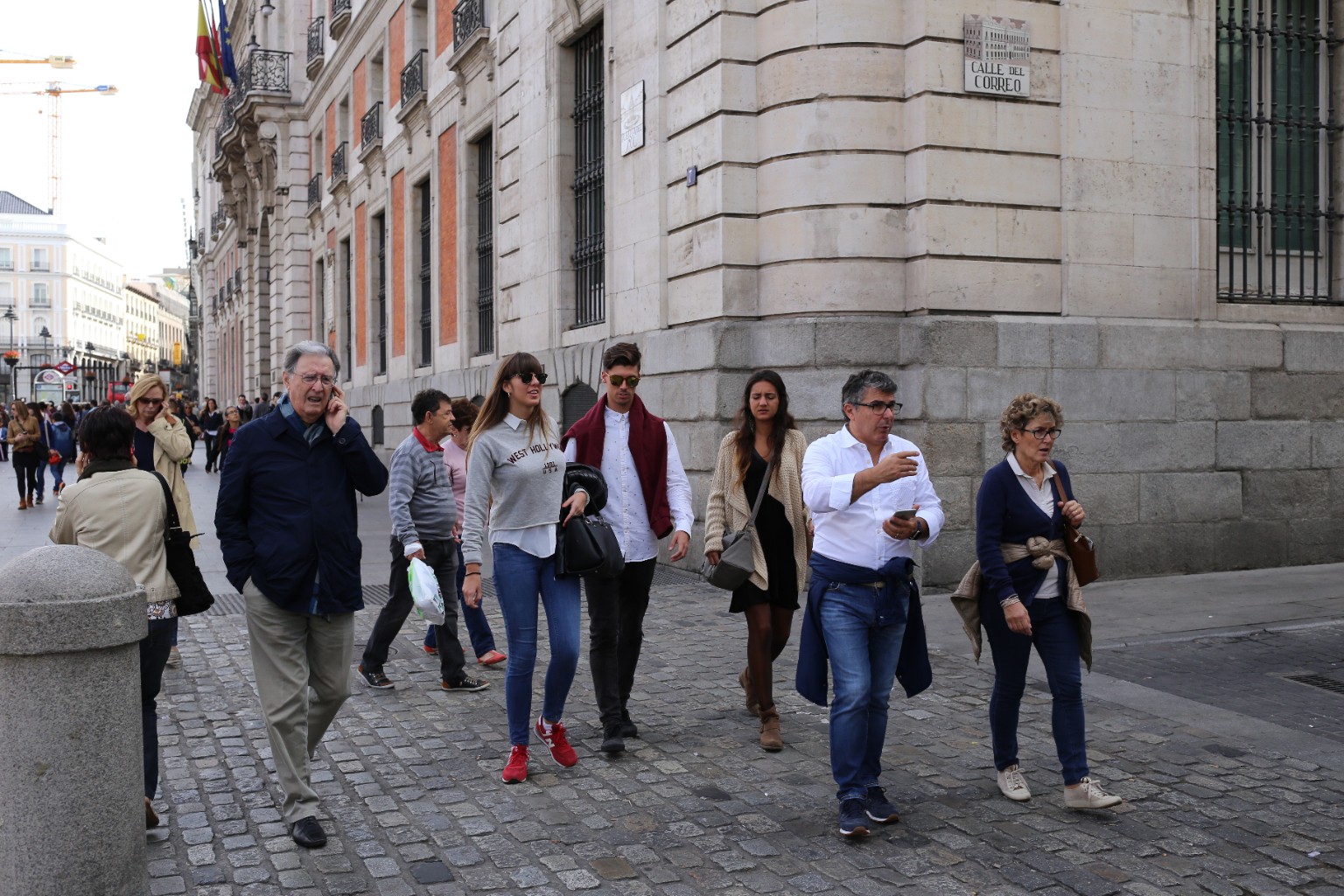
The interesting question is why such ordinary clothes can look so good.
The first explanation is that European casual fashion often retains some of the structure of traditional dressing. Even when people wear jeans and sneakers, they frequently combine them with a well-fitting shirt, a cardigan, a jacket, or a coat that gives the outfit a deliberate silhouette. The clothes do not have to be formal, but they rarely look entirely accidental. A simple white shirt can make faded jeans look more sophisticated, while a dark jacket can turn an otherwise unremarkable combination into something quietly elegant.
Another important ingredient is the willingness to mix styles without worrying too much about fashion categories. Athletic shoes are worn with tailored trousers. A sweatshirt appears over a collared shirt. A sweater is draped around the shoulders or tied at the waist rather than worn conventionally. A leather handbag accompanies sneakers, and a classic coat may be paired with a deliberately casual hairstyle. These combinations work because the individual pieces are familiar and practical. The contrast makes the outfit interesting without making it theatrical.
European street fashion also benefits from an appreciation of clothes that have already lived a little. A jacket does not need to look brand new, and a favorite pair of jeans may be more appealing after years of wear. The goal is not always to display a perfect, freshly purchased wardrobe. It is often to create a recognizable personal style from clothes that are comfortable, useful, and familiar.
This is especially visible in cities where walking remains an essential part of everyday life. Shoes must be comfortable enough for cobblestones, public transport, shopping, and long afternoons outdoors. Outerwear must accommodate changing temperatures. Bags need to be practical. Clothing is selected for actual daily routines, not merely for photographs. Paradoxically, these practical requirements can make urban fashion more convincing because the clothes seem to belong naturally to the people wearing them.
There is also an interesting relationship between age and style. In many European cities, dressing well is not regarded as something reserved for young people. Older men continue wearing smart jackets, well-chosen trousers, and polished casual shoes, while older women often maintain distinctive combinations of scarves, knitwear, handbags, and coats. Younger generations experiment with oversized silhouettes, sportswear, vintage pieces, and more conspicuous accessories. The styles differ, but the underlying idea remains similar: clothes are part of everyday public life, regardless of age.
Of course, Europe is hardly a single fashion culture. Milan’s polished sophistication is different from Berlin’s experimental streetwear, Copenhagen’s relaxed minimalism, or Madrid’s mixture of classic and contemporary clothing. Even within one city, neighborhoods, generations, occupations, and individual tastes produce enormous variety. The common denominator is not a particular jacket, brand, or pair of shoes. It is the freedom to develop a personal style without needing every item to announce itself.
One of the less obvious elements is restraint. A memorable outfit does not necessarily need an obvious luxury logo, an expensive watch, or a conspicuous designer handbag. Often the strongest visual impression comes from the relationship between colors, textures, and proportions. Navy blue, gray, white, beige, and denim are hardly adventurous colors, but they work beautifully together. A single brighter element, such as red sneakers or a colorful scarf, can provide enough contrast to make the entire outfit memorable.
The fashion industry encourages people to think of style as a sequence of purchases. A new season arrives, a new trend appears, and another wardrobe update supposedly becomes necessary. Yet much of the appeal of European street fashion comes from the opposite approach: buying relatively versatile pieces, wearing them repeatedly, and gradually discovering which combinations feel natural.
That does not mean Europeans are immune to fashion marketing, status symbols, or bad clothing choices. Nor does it mean everyone in Paris or Madrid looks effortlessly elegant. Plenty of people dress without giving fashion a second thought, and plenty of expensive outfits fail to impress. But the best examples of European street style suggest that looking good has less to do with the price of individual garments than with how comfortably they fit into a person’s life.
Perhaps that is the real secret. The most stylish person on the street is not necessarily the one wearing the most fashionable clothes. It may simply be the person who has stopped treating clothing as a performance and started wearing it as an expression of ordinary, everyday confidence.