The All-Black Column Is Still the Default British High Street Uniform
Everyone points a camera at the peacocks outside the shows. Fair enough, that’s the fun part. But if you want to know how a city actually dresses, you watch the ten minutes between one shop and the next. Nobody is posing. Nobody has been styled. And it looks like this.
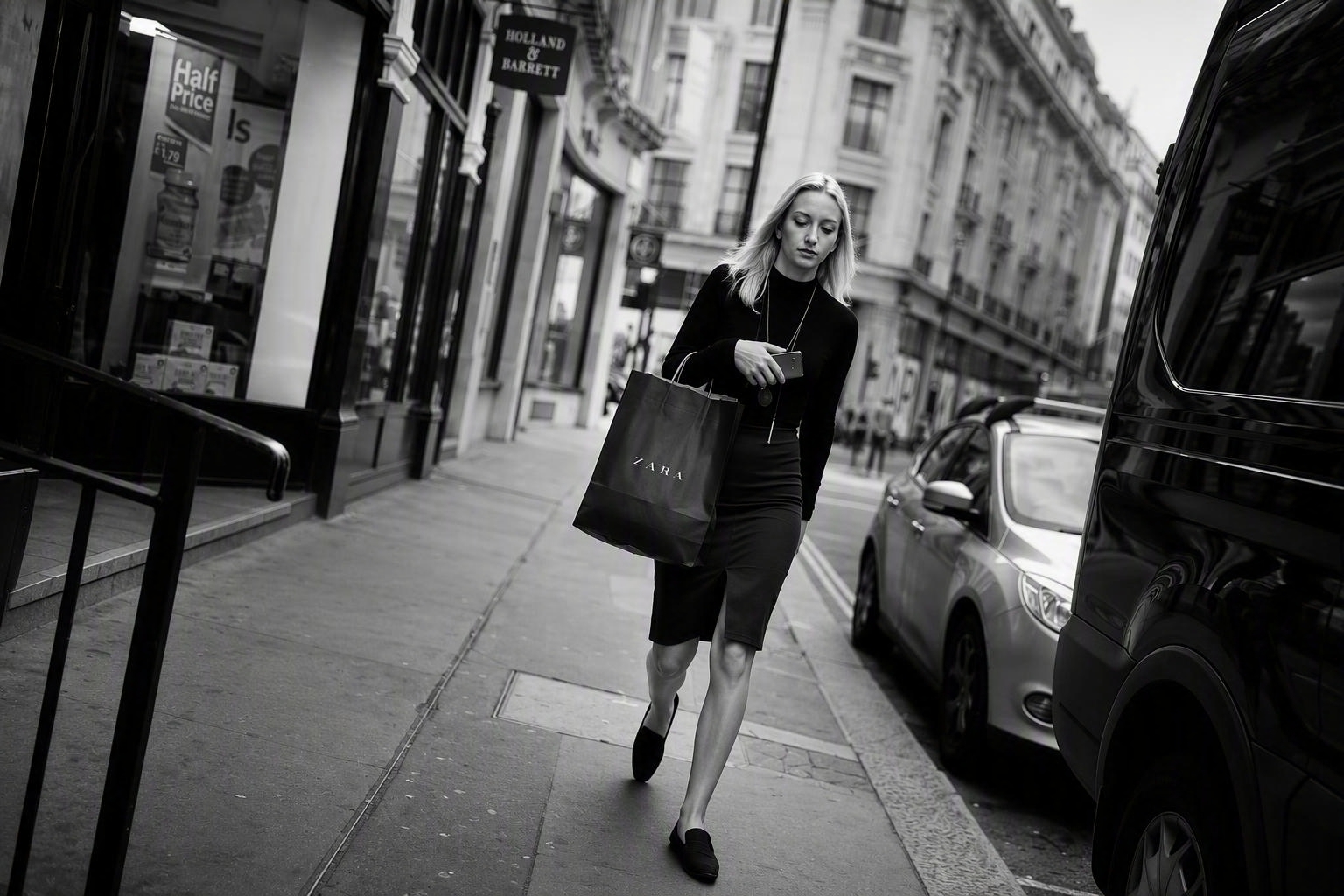
Fine-knit black turtleneck. Long black skirt. Two necklaces at different lengths. Phone in one hand, shopping bag in the other, eyes down, already thinking about the next thing. This is the most common outfit on any British shopping street and it has been for about fifteen years, which is worth taking seriously rather than dismissing as laziness.
Here’s why it works. The whole thing reads as one vertical line from shoulder to ankle. No waistband cutting across, no contrast at the hip, nothing to break the eye. A column is the most forgiving silhouette there is because it makes proportion somebody else’s problem. You could be any height and it would still do the same job.
The knit matters more than people give it credit for. It’s thin, it’s clinging slightly, and it has a bit of sheen under grey daylight. Put a chunky black jumper in the same outfit and you get a shapeless block. Put a stiff cotton shirt in and you get a waiter. The fine gauge is doing the actual work.
Then the necklaces. Two chains, two lengths, one of them long enough to sit well below the bust. That’s the entire styling decision in this outfit and it’s the right one. On a solid black field you need one thing travelling down the middle or the eye has nowhere to go. Some people use a scarf. Some use a long open coat. She’s using metal.
The Zara bag isn’t incidental either. Black basics are the one category where high street pricing genuinely competes with everything above it, because there’s no print to misregister, no colour to fade wrong, no pattern matching to get cheap. A £25 black skirt and a £300 black skirt look the same at three metres. That’s the actual reason this uniform spread, and it’s not a criticism of anyone.
Practical stuff on top of that. British weather is grey nine months of the year and black is the only thing that doesn’t look sad next to wet pavement. It goes from a desk to a restaurant without a change. It hides the coffee. It survives the Tube. Every one of those is a real reason and they compound.
Where it goes wrong is when there’s no variation in texture at all. Matte trousers, matte top, matte bag, matte shoes, and suddenly it does read as a work uniform. You need at least two surfaces disagreeing. Knit against something denser. A leather bag against wool. Anything, really, as long as the light hits two parts of the outfit differently.
The other failure mode is treating black as a decision you already made, so nothing else gets thought about. Fit still matters. A slightly-too-long sleeve is a slightly-too-long sleeve in any colour, and monochrome doesn’t rescue it, it just makes you less likely to notice while you’re getting dressed.
Best-dressed person on any high street is usually the one who stopped thinking about it three shops ago.