Binoculars Buying Guide: What to Buy When You're Not a Birder
This is what binoculars actually get used for. A terrace, a planter full of geraniums, palm fronds in the middle distance, and a mid-size roof-prism pair held up one-handed for maybe forty seconds at a time. No hide, no dawn start, no tripod. She’s got sunglasses on under the visor, which tells you everything about the light and about the eye relief she needs. It’s a good setup, and it is nothing like the setup every binocular review on the internet is written for.
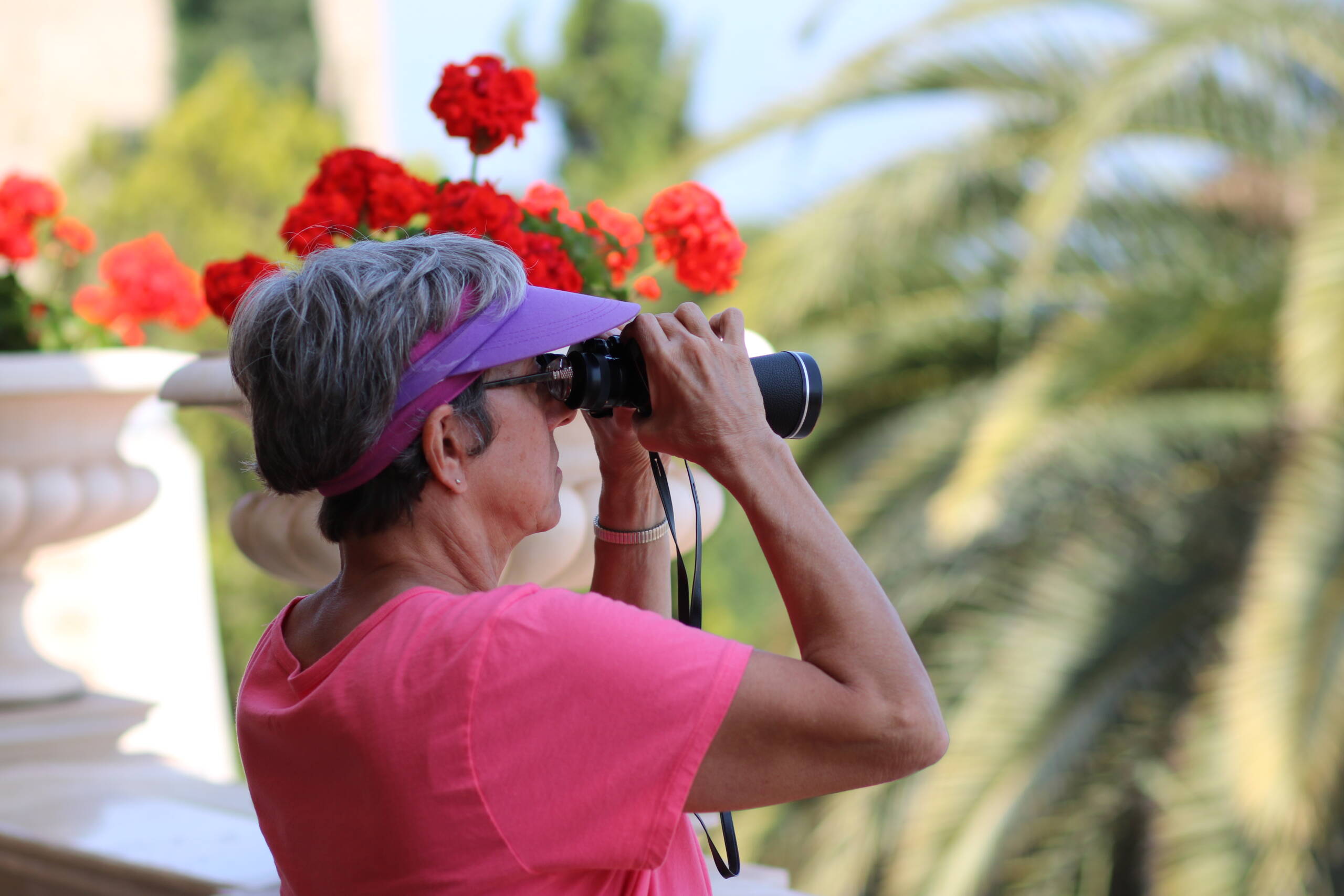
So here’s the guide for the rest of us. Bright light, short sessions, a bag that’s already full, and no interest in a lifetime hobby.
Magnification and objective size
The two numbers on the barrel are magnification and front lens diameter in millimetres. 8x42 and 10x42 are the two that matter. Divide the second number by the first and you get the exit pupil, the disc of light your eye actually receives. 8x42 gives you 5.25mm. 10x42 gives you 4.2mm. Bigger is more forgiving, especially if your hands aren’t perfectly steady or you’re wearing sunglasses.
Take 8x unless you have a specific reason. It’s brighter, the field of view is wider so you find things faster, and it doesn’t magnify your heartbeat. 10x is for open country and distant water. Anything advertised as 20x or 30x “high powered” with a free phone adapter is a toy, and you will never hold it still.
For a terrace, a boat or a stadium, 8x32 is the smarter compromise. Same brightness in daylight, noticeably less to carry.
The test: hold a pair up and read a street sign two hundred metres off for a slow thirty seconds. If the letters swim, the magnification is too high for you.
Glass, prisms and coatings
Roof prism is the straight-barrel shape in the photo. Porro prism is the old zigzag shape, optically cheaper to do well but bulky and awkward in a bag. Roof wins on ergonomics and has won the market.
What you’re paying for in a roof prism is phase correction and dielectric coating on the prism surfaces, plus ED or fluoride glass in the objective to kill the purple fringing you see on branches against a bright sky. Under about a hundred and fifty, you don’t get all three, and it shows the moment you look at something backlit.
Accessible: Celestron Nature DX ED 8x42, Nikon Prostaff P3 8x42, Vortex Crossfire HD 8x42. Mid: Vortex Diamondback HD 8x42, Nikon Monarch M5 or M7 8x42, Athlon Midas ED. Investment: Zeiss Conquest HD 8x42, Maven B1.2, Leica Trinovid HD, and at the top Zeiss Victory SF and Swarovski NL Pure. Secondhand: older Nikon Monarch 5s and Zeiss Conquests hold up beautifully and drop by half.
The honest version of the tier chart is that the jump from budget to mid is enormous and the jump from mid to alpha is small and expensive. Most people should buy mid and stop.
Eye relief, which is the one people get wrong
Eye relief is how far behind the eyepiece your eye can sit and still see the whole image. If you wear glasses or sunglasses, you need at least 16mm, and 18 to 20 is better. Below that you get a black tunnel with a small bright circle in the middle, and you will assume the binoculars are bad when the problem is the fit.
Look for twist-down eyecups with click stops rather than fold-over rubber, which perishes.
The test: wear whatever glasses you’ll actually be wearing, twist the cups down, and check that the circle of view fills the frame edge to edge.
Size, weight and how you carry them
Anything over about 700 grams stops coming with you. That’s the whole review. A 42mm pair is 650 to 800 grams and lives in a daypack. A 32mm pair is 450 to 550 and lives in a handbag. A true pocket pair like the Zeiss Victory Pocket 8x25 or Swarovski CL Curio 7x21 lives in a jacket and costs real money for the privilege, because small and good is harder than big and good.
Whatever you buy, replace the strap with a harness if you’ll be walking. The neck strap in the box is the reason people leave binoculars in the car.
Waterproofing, focus and warranty
Nitrogen or argon purged and O-ring sealed is standard now and worth insisting on, because the failure mode isn’t rain, it’s internal fogging when you carry a cold pair into humid air.
The focus wheel should run close focus to infinity in under two turns and move with one finger without backlash. Close focus under two metres is a genuine luxury if you like looking at flowers and insects rather than only at horizons.
Warranty is a real differentiator in this category. Vortex covers damage unconditionally and transferably, which quietly changes the maths on buying used.
The formula
Eight power, the largest objective you’ll genuinely carry, at least 16mm of eye relief, phase-corrected and sealed, from the mid tier rather than the top. Buy the configuration, then pick the brand.
Then leave them on the terrace table where you’ll reach for them.
As an Amazon Associate I earn from qualifying purchases.