Why Europeans Look Put Together in Casual Clothes: The Rules Hiding in a Madrid Street Photo
Nobody in this photo is dressed up. Sweatshirt, jeans, a cardigan, a white shirt, sneakers. It is a weekday walk across cobbles in central Madrid and everyone is wearing what they grabbed. And yet the whole frame looks composed, which is the thing people mean when they say Europeans are effortlessly cool. The effort is real, it just went in months earlier, at the point of buying. Once you own the right things, casual takes about four seconds.
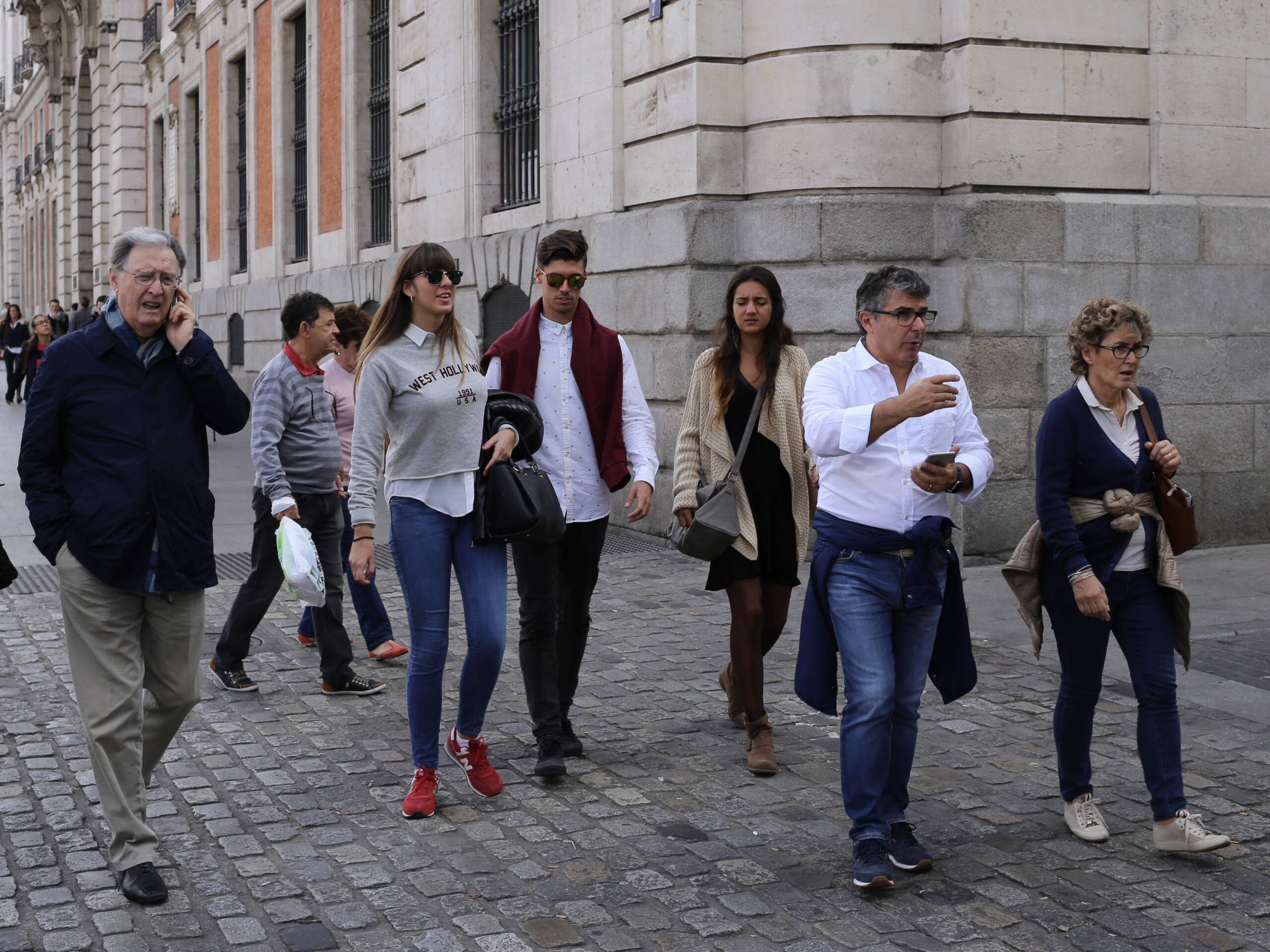
Look at the group again and the trick becomes obvious. Everything fits. Nothing is oversized by accident, nothing is tight by accident. The palette is quiet, with one red sneaker doing all the shouting. And almost every person is wearing a second layer that was not chosen for warmth. That is the formula, and it is buyable.
Fit Is the Whole Game, and It Costs Less Than You Think
The man on the left is wearing a navy raincoat and olive chinos, both perfectly ordinary, both cut to his actual shoulders and his actual leg. The young woman in the grey sweatshirt has jeans that end exactly at the ankle bone. None of this is expensive. It is the result of trying things on and rejecting the ones that were close enough.
What to look for: shoulder seams that land on the shoulder, sleeve ending at the wrist bone, trouser hem breaking once or not at all. For a sweatshirt or knit, the body can be roomy but the shoulder cannot drift.
- Accessible: Uniqlo, Zara Man and Woman basics, H&M Studio for the odd well-cut piece
- Mid: COS, Arket, Massimo Dutti, Everlane
- Investment: Margaret Howell, Aspesi, Officine Générale, A.P.C.
- Secondhand: Vinted and Vestiaire Collective, where the Italian and French labels turn up cheap because sizing scares people off
The fit test: raise both arms straight up. If the whole garment lifts with you, the shoulders are too small. If nothing moves and there is a pocket of air under the arm, they are too big.
A Collar Under Everything
The sweatshirt in the middle of the frame has a white shirt collar and hem peeking out. The woman on the right has a shirt collar sitting above a navy cardigan. This is the cheapest upgrade in casual dressing and almost nobody outside Europe bothers with it. A crew neck alone reads as gym. The same crew neck over a poplin shirt reads as a person who left the house on purpose.
Look for a shirt with a collar that holds its shape without stays, in white, pale blue, or a small pattern. Thin poplin layers better than oxford under knitwear, oxford looks better on its own.
- Accessible: Uniqlo poplin, Mango, Zara
- Mid: COS, Charles Tyrwhitt non-iron, Massimo Dutti
- Investment: Sunspel, Frank & Eileen, Emma Willis
- Secondhand: old Brooks Brothers oxfords, plentiful and better made than the current ones
The buying test: put the shirt on and pull a crew neck over it. If the collar collapses inward or the shirt bunches at the waist, it is too full in the body for layering.
The Layer That Is Not for Warmth
Burgundy sweater over the shoulders. Denim shirt knotted at the waist. Quilted jacket tied around the hips. Three people in one photo carrying a garment they are not wearing, and it is the single most European habit in the frame. It does two things. It adds a colour block where the outfit needed one, and it means you are never caught out when the temperature drops at eight in the evening.
What to look for: something light enough to knot without bulk. Fine gauge cotton or merino for shoulders, a soft chambray or unlined jacket for the waist. Anything stiff looks like luggage.
- Accessible: Uniqlo extra fine merino, Zara knits, an old denim shirt you already own
- Mid: COS, Arket lambswool, Scotch & Soda
- Investment: John Smedley, Loro Piana, Drumohr
- Secondhand: Shetland and lambswool crews from the 90s, sold by weight on Vinted
The fit test: knot it and walk ten steps. If it slides, the sleeves are too short or the knit is too heavy for shoulder wear.
Neutrals, Plus One Loud Thing
Count the colours in this photo. Navy, grey, cream, black, denim blue, tan, white. Then a pair of red New Balance 574s cutting through all of it. That ratio is the point. Six quiet pieces and one that is allowed to be seen. The moment you have two loud items in one outfit, they start arguing and the whole thing looks accidental.
Build the neutral base first, then buy the accent separately and deliberately. Sneakers, a bag, a scarf, a knit. One of them.
- Accessible: New Balance 574 or 327, Veja for the tonal version, Uniqlo scarves
- Mid: Adidas Samba and Gazelle in an odd colourway, Polène bags, Arket wool scarves
- Investment: Mansur Gavriel, Loewe, a Begg x Co scarf
- Secondhand: leather bags, always, since worn-in beats new here
The buying test: lay the accent piece on top of three outfits you already own. If it only works with one, it is not an accent, it is a project.
Shoes That Are Made for Cobblestones
Every pair of shoes in this photo can handle a full day of uneven granite. Suede ankle boots, leather sneakers, plain lace-ups. No heels, no flimsy soles, no shoe that is being protected from the ground. European cities are walked, so European shoes are chosen for walking, and that constraint quietly forces good taste. Fragile shoes look precious. Sturdy ones look lived in.
Look for a rubber or leather sole with visible thickness, a heel counter that does not fold when you press it, and a colour that goes with denim.
- Accessible: New Balance, Camper, Clarks desert boots
- Mid: Veja, Blundstone, Astorflex, Doucal’s on sale
- Investment: Common Projects, Church’s, Alden
- Secondhand: resoleable leather boots, since the sole is the only part that wears out
The fit test: walk downhill in them in the shop, or at least on your heels. Anything that slips at the back will be agony after two hours on stone.
Making It Yours
Swap the sweatshirt for a fine merino crew if you want it dressier, or a rugby shirt if you want it younger. Swap skinny jeans for a straight leg, which reads more current and is easier to buy well. Trade the crossbody for a small leather shoulder bag if you carry less, or a canvas tote if you carry more. Change the red sneaker to green, burgundy, or a pale yellow, since the point is that one thing has a colour, not which colour it is.
The formula underneath all of it: buy fewer things, in fit, in colours that agree with each other, and always carry a second layer you have no intention of putting on.
As an Amazon Associate I earn from qualifying purchases.